
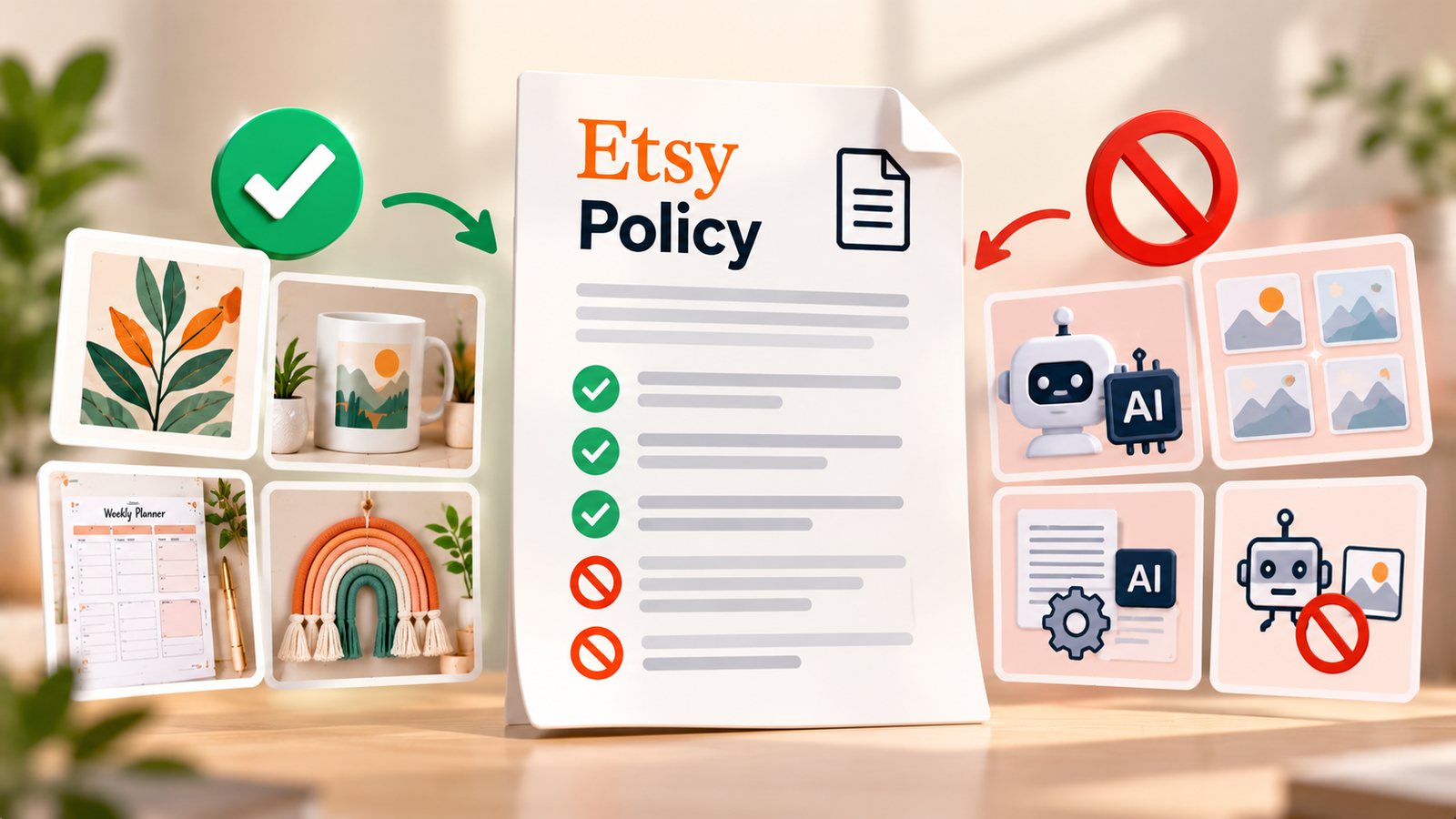
Etsy has announced important policy updates that every seller should understand. The changes focus on artificial intelligence (AI), creative involvement in product creation, listing image requirements, and transparency across the marketplace.
Whether you sell handmade products, vintage items, digital downloads, craft supplies, or AI-assisted creations, understanding these changes can help you avoid policy violations and maintain a trustworthy Etsy shop.
Announced on October 22, 2026, Etsy’s latest updates clarify how sellers can use AI, what types of AI-generated content are permitted, and how product images must represent the items being sold.
In this guide, we explain the major changes, how they may affect your Etsy business, and what you should review in your shop.
Quick Summary: What Has Changed?
Here are the key points Etsy sellers should know about the October 2026 policy updates.
- AI-generated creations: Eligible AI-assisted products remain permitted when sellers meet Etsy’s creativity, disclosure, and other applicable requirements.
- Human creative involvement: Etsy prohibits fully automated, bot-generated products that lack individualized human creative input.
- AI-generated instructions: AI-generated functional instructions, such as recipes and craft patterns, are prohibited under the updated policy.
- Listing image requirements: Sellers must ensure their images accurately represent the products they offer.
- Physical product photographs: Most physical product listings require at least one unedited photograph of the actual item against a real background, subject to applicable exceptions.
- Digital product previews: Digital listings should accurately show the files and content buyers will receive.
- AI transparency: Sellers must disclose AI use when required by Etsy’s Creativity Standards.
- Reporting and enforcement: Etsy is introducing additional guidance and reporting measures to address misleading AI imagery and policy violations.
These updates do not mean that every AI-assisted product or digitally edited photograph is prohibited. The actual product, the seller’s creative contribution, and the applicable listing requirements all matter.
1. Etsy’s Updated AI Policy: What Sellers Need to Know
Artificial intelligence has become an increasingly common tool for online sellers. It can help with artwork, product development, design exploration, and other creative tasks.
Etsy’s updated policy does not impose a blanket ban on AI-generated creations. Instead, it emphasizes meaningful human creative involvement, transparency, and compliance with the marketplace’s Creativity Standards.
What AI-assisted products are permitted?
Eligible products may be created with AI assistance when sellers contribute their own creative direction, prompts, selection, curation, or other meaningful creative decisions.
For example, a seller might use AI to explore design concepts, refine an original product idea, or assist with artwork before reviewing and preparing the final item.
However, simply generating large quantities of products automatically and publishing them without individual creative involvement does not satisfy Etsy’s requirements.
What should Etsy sellers do?
- Make their own creative decisions during product development.
- Review and curate AI-generated results.
- Ensure products meet their intended quality and purpose.
- Disclose AI use in listing descriptions when required.
- Respect intellectual property rights and other Etsy policies.
- Avoid fully automated product creation and publishing workflows that lack individual human involvement.
Using AI as a supporting tool is different from allowing a system to create and publish products without meaningful seller participation.
Important: AI disclosure does not make a prohibited product permissible. Sellers must satisfy all applicable requirements, regardless of which tools they use.
2. Etsy Prohibits AI-Generated Functional Instructions
One of the most important changes concerns functional instructions.
Etsy prohibits AI-generated instructions intended to help buyers perform tasks or achieve specific results. This includes areas such as recipes, craft patterns, and other instructional content covered by the updated policy.
Examples of products that require particular attention include:
- Knitting and crochet patterns.
- Sewing and embroidery patterns.
- Recipes and cooking instructions.
- DIY project guides.
- Building and woodworking plans.
- Repair and assembly instructions.
- Instructional guides and other functional how-to content.
The central issue is whether the product contains functional instructions generated by AI, rather than merely containing AI-assisted artwork or creative elements.
If you sell instructional products, review the actual content and purpose of each listing against Etsy’s updated policy.
Do not assume that adding human editing to AI-generated instructions automatically makes them compliant.
3. New Etsy Listing Image Requirements
Etsy has also updated its Listing Image Requirements to improve transparency and help buyers understand what they are purchasing.
Your listing photographs are an important part of your product presentation. They should accurately represent the product and avoid creating expectations that the delivered item cannot meet.
Requirements for physical products
For most physical products, Etsy requires at least one unedited photograph of the actual item against a real background.
This required image must not be edited or changed. Applicable exceptions and category-specific requirements should be checked in Etsy’s official policy.
Other images may use editing tools, including AI, provided they meet Etsy’s rules and accurately represent the product.
For example, a seller should not use AI to make a product appear to have different materials, features, dimensions, or quality than the actual item.
Requirements for digital products
Digital products need clear, accurate representations of the files buyers will receive.
Depending on the product, useful listing images may include:
- Screenshots of the actual digital product.
- Previews of included files.
- Sample pages or representative content.
- Accurate demonstrations of the product’s features.
- Mockups that clearly communicate what is included.
Promotional mockups can improve the presentation of a listing, but they should not mislead buyers about the actual contents of a digital download.
Can Etsy sellers still use AI-generated listing images?
AI-assisted images are not automatically prohibited. Their acceptability depends on the applicable image requirements and whether the image accurately represents the product.
For physical products, remember the requirement for an unedited photograph of the actual item. For digital products, make sure buyers can understand what they will receive.
Read the official Etsy Listing Image Requirements before changing your product photography workflow.
4. AI Disclosure: Do Etsy Sellers Need to Mention AI?
Yes. Etsy requires disclosure of AI use in listing descriptions for creations covered by its AI disclosure rules.
If you use AI to assist with an eligible product, your description should accurately explain that use where required.
For example, a seller offering AI-assisted artwork could state:
“This design was created with the assistance of AI tools, with human creative direction, selection, and review.”
Only use this description if it accurately reflects your actual process.
Sellers should not claim that an item was entirely handmade or independently illustrated when that description would misrepresent how it was created.
Transparency helps buyers make informed decisions and reduces the risk of misleading product descriptions.
5. Fully Automated Product Creation Is Not Allowed
Etsy’s updated policy reinforces the importance of individual human creative involvement in listed products.
A seller should not rely on a fully automated system to generate products and publish listings without meaningful individual creative input.
Consider these examples.
Example 1: A seller-led workflow
A seller develops a product concept, uses AI to assist with design exploration, selects suitable results, reviews the final work, makes creative decisions, and prepares the product for sale.
This demonstrates a seller-led creative process, although the product must still satisfy Etsy’s other requirements.
Example 2: A fully automated workflow
A system generates products in bulk, creates descriptions, prepares listing images, and publishes listings without meaningful individual human involvement.
This type of fully automated product creation and publishing is prohibited under the updated policy.
Can sellers still automate their Etsy business?
Technology can still help sellers manage repetitive administrative work, organize research, improve productivity, and support other business processes.
The important distinction is between using tools to support your business and replacing the required human creative involvement in product creation.
Sellers should also review Etsy’s applicable rules before using automation that interacts directly with their shops or marketplace accounts.
6. Etsy Introduces Stronger AI Image Reporting and Detection Measures
Etsy’s announcement describes additional measures intended to address misleading AI imagery and improve marketplace transparency.
These include:
Guidance during listing creation: Etsy is adding guidance to help sellers understand its expectations when AI-generated imagery is detected.
Improved detection and enforcement: Etsy is investing in tools to identify misleading imagery and other potential policy violations.
A new reporting option: Buyers and other marketplace participants will be able to report listings they believe use AI imagery in a misleading way. Etsy says these reports will initially help it understand concerns and will not automatically trigger immediate enforcement.
Greater transparency: Etsy plans to explore additional ways to help buyers understand when AI is used in content they encounter.
These measures do not mean that every listing containing AI-generated imagery will automatically be removed. Compliance depends on the relevant policy and the circumstances of the listing.
7. What Happens If Your Etsy Shop Violates the Policies?
The consequences of a policy violation depend on the nature and severity of the issue.
Potential consequences include:
- Removal of a listing that violates Etsy’s rules.
- Refunds or other remedies in applicable cases.
- Additional enforcement for repeated or serious violations.
- Suspension or termination of a seller’s account in severe cases.
For example, misleading photographs, inaccurate descriptions, or products that violate Etsy’s Creativity Standards can put a listing or shop at risk.
If Etsy removes a listing, review the notification carefully and follow the applicable appeal process through Shop Manager when available.
Do not assume that every removal involving AI is caused by AI use alone. The specific policy cited by Etsy is important.
8. Etsy Seller Compliance Checklist for October 2026
Use this checklist to review your shop following the latest updates.
- Review products created with AI assistance.
- Confirm that your creative process meets Etsy’s Creativity Standards.
- Remove or revise products containing prohibited AI-generated functional instructions.
- Check that AI use is disclosed where required.
- Review listing images for accuracy and compliance.
- Include clear previews of the actual contents of digital downloads.
- Ensure physical product listings meet the applicable unedited-photo requirement.
- Verify product descriptions, included files, dimensions, and other important details.
- Check intellectual property rights and other relevant Etsy policies.
- Review any policy notifications in Shop Manager.
- Revisit the official policy pages for future changes.
Completing this review can help you identify potential compliance issues before they become larger problems.
9. How These Updates Affect Different Types of Etsy Sellers
The impact of the changes depends on what you sell and how you create and present your products.
| Seller type | What to review |
|---|---|
| Handmade product sellers | Product authenticity, creative involvement, and accurate photographs. |
| Digital download sellers | Accurate previews, product contents, and applicable AI disclosure requirements. |
| AI-assisted design sellers | Human creative contribution, disclosure, and prohibited content restrictions. |
| Craft pattern sellers | Whether functional instructions comply with the new AI restrictions. |
| Vintage sellers | Accurate product representation and applicable listing image requirements. |
| Craft supply sellers | Accurate product images, descriptions, and applicable category requirements. |
| Sellers using automated workflows | Whether product creation and publishing involve the required individual human creative input. |
Not every rule applies identically to every product category. Always check the official policy and any relevant exceptions.
Frequently Asked Questions
Has Etsy banned AI-generated products in 2026?
No. Etsy continues to allow eligible AI-assisted creations that satisfy its Creativity Standards, disclosure requirements, and other applicable policies. However, fully automated product creation without individualized human creative involvement and AI-generated functional instructions are prohibited.
Can I use ChatGPT or other AI tools for my Etsy business?
You can use AI tools to support eligible creative and administrative tasks, provided your products and workflows comply with Etsy’s policies. Review the restrictions on functional instructions and automated product creation before publishing.
Are AI-generated listing images allowed?
Not automatically prohibited. AI-assisted images must comply with Etsy’s listing image rules and accurately represent the product. Most physical product listings require at least one unedited photograph of the actual item against a real background.
Do I need to disclose AI use in my listings?
Yes, where required by Etsy’s AI disclosure rules. Disclose AI use in the listing description and describe your process honestly.
Can I use automation to create and publish hundreds of products?
Etsy prohibits fully automated, bot-generated product creation without individual human creative involvement. Do not assume that automated publishing becomes compliant simply because a person operates the system.
Can my shop be suspended for an AI policy violation?
Policy violations may lead to listing removal or further enforcement, depending on the circumstances and severity. Review Etsy’s specific notification and applicable appeal options if action is taken against your shop.
Where can I read Etsy’s official policy update?
You can read the announcements directly in Etsy’s Seller Handbook:
- Important Updates to AI Use on Etsy
- What Is Etsy’s Stance on AI Creations?
- Etsy Listing Image Requirements
Final Thoughts
Etsy’s October 2026 policy updates reinforce three important principles: human creative involvement, transparent AI use, and accurate product representation.
AI can remain a useful tool for eligible product creation and business workflows, but sellers must understand where Etsy draws the line.
Review your existing listings, check your creation process, update disclosures where required, and make sure your product images reflect what buyers will actually receive.
Most importantly, do not rely on assumptions or social media summaries when making compliance decisions. Read Etsy’s official policies and follow the requirements that apply to your product category.
For Etsy sellers, staying informed is an important part of building a sustainable business.
Official Sources
- Important Updates to AI Use on Etsy — Etsy Seller Handbook
- What Is Etsy’s Stance on AI Creations? — Etsy Seller Handbook
- Listing Image Requirements — Etsy
- Etsy Prohibited Items Policy
Disclaimer: This article is for informational purposes only and is not legal advice. Etsy policies can change, so sellers should consult the official policy pages for the latest requirements.