
Introduction
You have created a product you are proud of. Your listing looks good, the description explains what buyers will receive, and the price feels reasonable.
You publish it on Etsy and wait for visitors.
But the views never really come.
If this sounds familiar, you are not alone. One of the frustrating parts of selling on Etsy is that creating a good product and getting it discovered are two different challenges.
A buyer searching for a printable activity, a personalized gift, or a handmade accessory needs to find a listing that matches what they have in mind. If your listing uses different language from the buyer’s search, Etsy may not recognize it as a relevant match.
That is where keyword research comes in.
Etsy keyword research is not about stuffing as many search terms as possible into your listing. It is about understanding how buyers search and describing your product in language they actually use.
In this guide, we will walk through how to find relevant keywords, choose the right tags, write clear titles, understand search intent, and audit existing listings. You will also learn how to use research tools such as Enlistra to organize your findings and make more informed SEO decisions.
What Is Etsy Keyword Research?
Etsy keyword research is the process of discovering and evaluating the words and phrases buyers use when looking for products on Etsy.
These keywords can describe a product, its purpose, its style, its audience, or the problem it solves.
For example, imagine you sell digital downloads for children.
A buyer might search for:
- Dinosaur coloring pages
- Preschool alphabet worksheets
- Printable matching game
- Kindergarten learning activities
- Kids activity bundle
Each phrase describes a slightly different need. Understanding those differences helps you decide which terms accurately represent your product.
Keyword research also helps you avoid a common mistake: choosing keywords simply because they seem popular.
A keyword can attract a lot of searches but still be a poor fit for your product. If someone searches for a physical toy and your listing offers a digital printable, that visitor may leave as soon as they understand what you sell.
The goal is not to attract everyone. It is to help the right buyers find the right product.
How Etsy SEO Works
Etsy SEO, or search engine optimization, involves making your listings easier for relevant shoppers to discover through Etsy search.
When a buyer enters a search query, Etsy first identifies listings that match the query and then ranks the matching results using a range of factors.
According to Etsy’s official guide to how Etsy search works, the platform considers information across a listing, including its title, tags, attributes, description, first photo, reviews, and other signals. Listing quality, customer experience, and engagement also matter.
This means keywords are important, but they are not the whole story.
A listing with relevant keywords can still struggle if the product does not appeal to buyers, the images are unclear, or the offer does not meet their expectations.
Think of Etsy SEO as two connected tasks:
First, relevance: Help Etsy understand what your product is and which searches it matches.
Second, conversion: Help shoppers understand the offer, feel confident about it, and decide whether it meets their needs.
Good keyword research supports the first task. A strong listing experience supports the second.
Step 1: Start With Your Product, Not a Keyword Tool
Before searching for keywords, make sure you understand the product you are trying to sell.
This may sound obvious, but it is easy to get distracted by promising search terms and forget whether they genuinely describe your offer.
Ask yourself four questions:
- What exactly am I selling?
- Who is most likely to buy it?
- Why would someone want it?
- What makes it different from similar products?
Let’s use a simple example.
Suppose you sell a downloadable dinosaur coloring pack containing 30 pages.
Your product has several useful characteristics:
- It is a digital download.
- It contains dinosaur illustrations.
- It is designed for coloring.
- It may appeal to parents, teachers, or caregivers.
- It contains multiple pages in one pack.
These characteristics give you a starting list of possible keyword themes.
You could investigate phrases such as “dinosaur coloring pages,” “dinosaur coloring book,” “printable dinosaur activities,” and “dinosaur activity pack.”
Not every phrase will be equally relevant. For example, if your product is only a collection of coloring sheets, a phrase implying a complete educational curriculum would be misleading.
Always begin with an accurate description of what you sell.
Step 2: Find Keywords Buyers Might Actually Search
Once you understand your product, start collecting relevant search phrases.
You do not need to guess every keyword from scratch. There are several practical places to look.
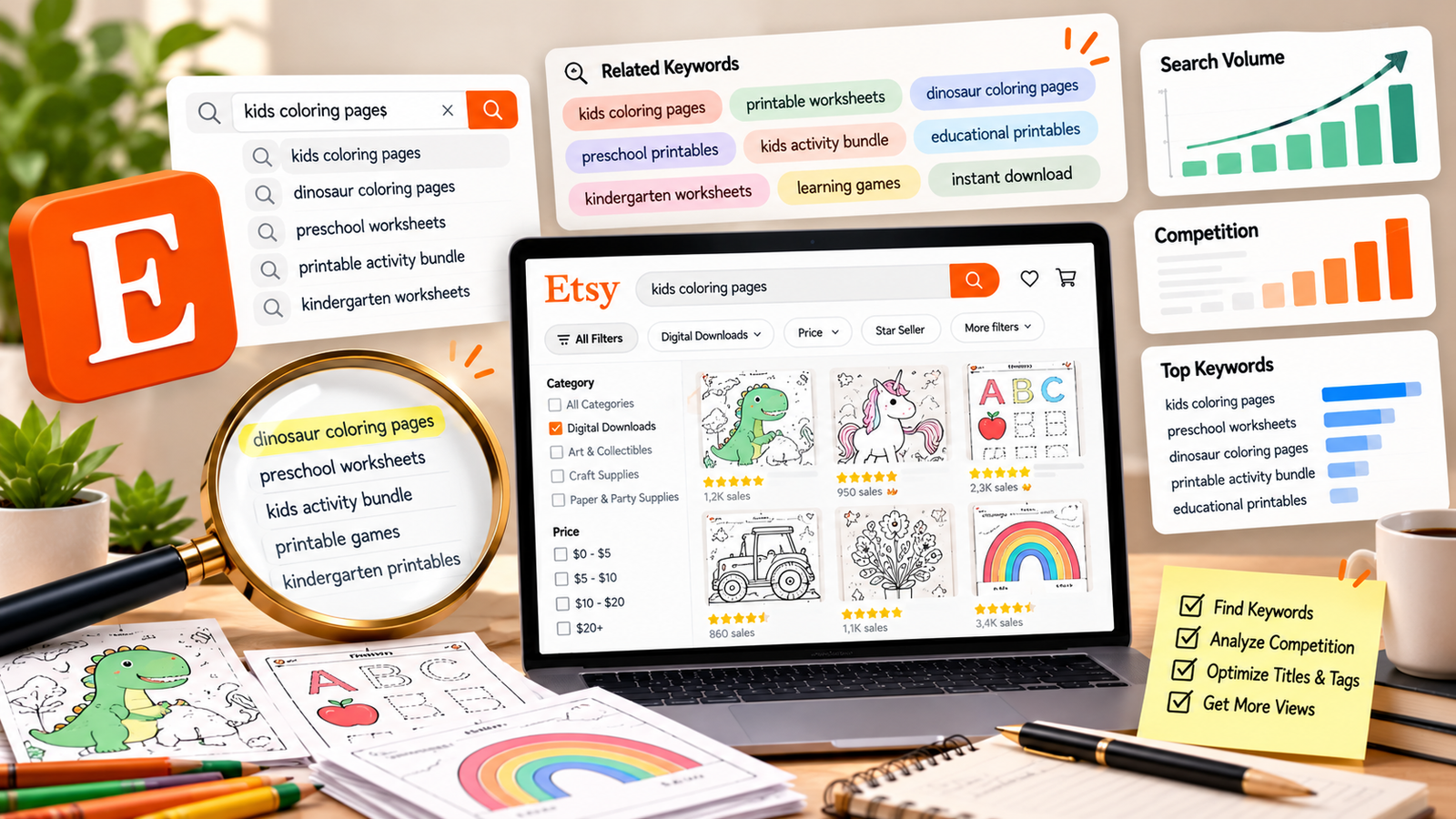
Use Etsy search suggestions
Open Etsy and begin typing a phrase related to your product.
For example, enter “dinosaur coloring” and examine the suggestions that appear.
You may discover related phrases that you had not considered. Repeat the process with variations such as “printable dinosaur,” “kids coloring pages,” or “preschool dinosaur activities.”
Treat these suggestions as clues, not proof that a keyword is profitable. They help you discover language worth investigating further.
Research competing listings
Look at listings that offer products similar to yours.
Pay attention to the words used in their titles, the product formats they describe, and the audiences they appear to target.
You are not looking for phrases to copy blindly. You are trying to understand how sellers describe products in your category and identify relevant terms you may have overlooked.
A competitor’s keyword is only useful to you if it accurately describes your own product.
Check your own Etsy Shop Stats
If your shop is already receiving visits, your statistics can provide particularly useful information.
Look for the search terms that bring visitors to your listings.
You may discover that buyers find your product through a phrase you had not intentionally targeted. That can give you ideas for refining your titles, tags, and descriptions.
If a search term is bringing relevant visitors who purchase, it deserves closer attention. If it attracts visitors who leave without engaging, investigate whether the keyword accurately matches the product and buyer expectations.
Use keyword research tools
Research tools can help you collect keyword ideas, compare available metrics, and organize your findings.
For example, Enlistra can be used as part of a workflow for investigating keywords and comparing relevant product and competitor information. The exact metrics available depend on the tool’s data sources and current features.
When reviewing keyword data, record the search phrase, the available demand indicators, the competition indicators, and the date of your research.
This creates a useful reference for future decisions.
Step 3: Understand Search Volume and Competition
Finding a keyword is only the beginning. The next step is deciding whether it is worth targeting.
Two metrics commonly used in keyword research are search volume and competition.
Search volume refers to how frequently a keyword is searched during a specified period, according to the source providing the data.
Competition refers to how many listings or competing products are associated with that keyword, depending on the tool’s methodology.
These metrics can help you compare opportunities, but they should not be treated as exact predictions of your future traffic or sales.
Should you always choose high-volume keywords?
No.
Consider these two hypothetical keyword examples:
| Keyword | Illustrative demand | Competition |
| Coloring pages | High | Very high |
| Dinosaur coloring pages for kids | Moderate | Moderate |
These descriptions are examples, not live marketplace measurements.
The broader phrase may reach a larger audience, but it also covers many different types of products. The more specific phrase may be a better match for someone who already knows what they want.
A smaller, more relevant audience can sometimes be more valuable than a large audience with mixed intentions.
How to evaluate keyword opportunities
For each candidate keyword, consider:
- Is the phrase directly relevant to my product?
- Does it describe what the buyer wants?
- Is there evidence of meaningful search interest?
- How strong and relevant are the competing listings?
- Can my product offer a credible reason for someone to choose it?
Do not reject a keyword simply because it has competition. Competition often exists because buyers are interested in the category.
Instead, look for a combination of relevance, demand, and a realistic way to differentiate your product.
Step 4: Understand Long-Tail Keywords
Long-tail keywords are more specific search phrases that often describe a product, audience, style, or use case in greater detail.
For example:
- Broad keyword: Coloring pages
- More specific keyword: Dinosaur coloring pages
- More specific still: Printable dinosaur coloring pages for kids
The more specific phrase may have fewer searches, but it can communicate a clearer intention.
Imagine two shoppers.
One searches for “planner.” They could be looking for a daily planner, a wedding planner, a digital planner, a printable planner, or a notebook.
The other searches for “printable weekly planner for students.” This shopper has already narrowed down the format, purpose, and audience.
If your product is a printable weekly planner designed for students, the second phrase is likely to be more relevant.
How to find useful long-tail keywords
Start with your main product phrase and add meaningful details.
You can explore:
- Audience: teacher, student, parent, beginner
- Purpose: organize, practice, learn, celebrate
- Format: printable, editable, digital download
- Style: minimalist, colorful, vintage
- Occasion: birthday, wedding, graduation
- Product features: personalized, undated, reusable
Only use the combinations that accurately describe your product.
Long-tail keywords are not automatically low-competition or profitable. Their value depends on relevance, demand, competition, and buyer intent.
Step 5: Choose the Right 13 Etsy Tags
Etsy allows sellers to use up to 13 tags per listing. Each tag gives Etsy another opportunity to match the listing with a relevant search.
Etsy recommends using all available tags, choosing descriptive multi-word phrases, and avoiding unnecessary repetition. Its official tagging guidance explains how tags help connect listings with shoppers’ searches.
Let’s return to the dinosaur coloring pack.
Here is an illustrative set of tag ideas to investigate:
| Tag idea | What it describes |
| dinosaur coloring | Main product theme |
| kids coloring pages | Audience and format |
| printable dinosaurs | Product format and subject |
| dinosaur activity | Intended use |
| preschool coloring | Age-related use |
| animal coloring | Broader subject category |
| kids activity pack | Product format |
| dinosaur art pages | Product content |
| rainy day activity | Possible use case |
| homeschool printable | Relevant audience |
| classroom activity | Educational use |
| dinosaur gift | Gift-related intent |
| instant download | Digital delivery |
These are starting ideas, not a verified final keyword set. Before using them, check that each phrase describes your product accurately, fits Etsy’s current tag-length limits, and is worth testing against your actual keyword research.
Avoid repeating the same phrase
Suppose you use tags such as:
- Dinosaur coloring
- Dinosaur coloring pages
- Dinosaur coloring book
These phrases overlap heavily.
Some overlap may be appropriate, but using all 13 tags on minor variations of the same phrase can leave other relevant search opportunities unexplored.
You could instead consider terms related to the audience, activity, format, or use case, provided they accurately describe the product.
Do not force unrelated keywords into your tags
A popular phrase is not useful if it attracts the wrong shoppers.
For example, a dinosaur coloring download should not use unrelated tags simply because they appear to have high search demand.
Misleading keywords create a poor experience for buyers and do not help build a sustainable shop.
Step 6: Write Etsy Titles That Make Sense to Buyers
Your title needs to tell shoppers what you are selling.
It should include meaningful descriptive keywords, but it should also be easy to understand at a glance.
Consider this example.
Less effective:
Dinosaur Coloring Pages, Kids Coloring, Dinosaur Book, Printable Pages, Animal Art, Preschool Activity, Dinosaur Gift
Clearer alternative:
Printable Dinosaur Coloring Pages for Kids: 30-Page Activity Pack
The second title communicates the product, audience, format, and quantity without turning the title into a list of repeated search phrases.
This matters because buyers scan search results quickly, often on mobile devices.
Etsy’s current keyword guidance recommends clear, descriptive titles written for people rather than search algorithms. The order of a phrase in the title is not itself a ranking advantage, although placing the most important description first can help shoppers understand the product quickly.
You can read Etsy’s official guidance on keywords and titles.
A simple title-writing process
Start by identifying the most important product phrase.
Then add one or two details that help the buyer understand the offer.
For example:
Product: Printable weekly planner for students
Possible title: Printable Weekly Planner for Students: Undated Study Planner
This title is clear and descriptive. It tells shoppers what the item is and who it is for.
You do not need to include every possible keyword in the title. Use tags, attributes, categories, and the description to provide additional relevant information.
Always follow Etsy’s current title policies and make sure the title accurately represents the item.
Step 7: Use Keywords Naturally in Your Description
A listing description serves two purposes: it helps Etsy understand your product, and it helps customers decide whether to buy it.
Start by explaining what the product is and who it is for.
For the dinosaur coloring pack, you might begin with:
“Keep little dinosaur fans busy with this printable dinosaur coloring pack featuring 30 pages to color at home, during quiet time, or in the classroom. Download the files and print the pages you need for your next activity.”
This opening naturally includes relevant phrases while explaining the product’s contents and intended use.
You can then provide practical details, such as:
- Number of pages
- File format
- Paper size
- Whether the product is digital or physical
- How customers receive the files
- Any printing or usage instructions
Avoid repeating the same keyword unnaturally in every sentence. A useful description answers the buyer’s questions and sets clear expectations.
Step 8: Understand Search Intent
Search intent is the reason behind a buyer’s search.
Understanding it can help you choose more relevant keywords and create products that meet real needs.
Consider three searches:
“Kids coloring pages”
The shopper may be exploring ideas and comparing options.
“Printable dinosaur coloring pages”
The shopper has a clearer idea of the product they want.
“30-page dinosaur coloring pack instant download”
The shopper may be looking for a specific format and quantity.
These examples suggest different levels of specificity, although you cannot know a buyer’s exact intention from a phrase alone.
Why search intent matters
Imagine that your product is a digital planner.
If you target a phrase that mainly attracts people looking for physical notebooks, you may attract visitors who are not interested in your offer.
Likewise, a shopper searching for an editable Canva template may not want a flattened PDF that cannot be edited.
The better your keywords match the actual product, the more likely visitors are to understand what you offer.
When researching a keyword, ask yourself:
“What would someone expect to see if they searched for this phrase?”
Then compare those expectations with your listing.
Step 9: Audit Your Existing Etsy Listings
Keyword research is not just something you do before publishing a product. It is also useful for improving listings that are already live.
If a listing is not performing as expected, resist the temptation to change every keyword at once.
First, identify the problem.
If your listing receives very few impressions
Review whether the title and tags accurately describe the product. Check your categories and attributes, and investigate whether the keywords are relevant to the intended audience.
Low impressions can have several causes, so do not assume the keywords are the only problem.
If your listing receives impressions but few clicks
Look at the first image, title clarity, product presentation, and price.
A shopper may see your listing but decide that it does not look relevant or appealing enough to open.
Changing tags alone may not solve this problem.
If your listing receives clicks but few sales
Check whether the product matches the promise made in the title and images.
Review the description, pricing, file details, personalization options, delivery information, and customer expectations.
If the keywords attract the wrong audience, revise them carefully. If the traffic is relevant, the issue may be the offer or listing experience instead.
If a listing is already bringing relevant traffic
Avoid making large changes without a reason.
Review your existing search terms, identify opportunities, and make measured adjustments so you can learn what helps.
Etsy recommends using Shop Stats and reviewing underperforming listings as part of an ongoing search optimization process. You can also consult its official Etsy search guide.
Step 10: Use Enlistra to Organize Your Keyword Research
Research becomes much easier to manage when you have a consistent way to compare keywords, products, and competing listings.
Enlistra brings keyword research together with product research, shop analysis, and listing analysis, giving sellers a way to investigate several parts of the Etsy SEO process in one workspace.
Here is a practical workflow you can follow.
1. Start with a product idea.
Choose one listing you want to create or improve.
2. Research relevant keywords.
Collect phrases that describe the product, its intended audience, and the problem it solves. Use the available keyword data to compare potential opportunities.
3. Examine competing listings.
Review similar products to understand their positioning, pricing, presentation, and available performance indicators.
4. Select relevant keywords.
Choose phrases based on relevance, available demand evidence, competition, and how accurately they describe your product.
5. Optimize your listing.
Write a clear title, use relevant tags, select appropriate categories and attributes, and create a useful description.
6. Review the results.
After publishing or updating your listing, monitor its traffic and performance. Use what you learn to decide whether further changes are necessary.
Enlistra should support your decisions, not replace your judgment. Search metrics and opportunity scores are useful only when you understand what they measure and their limitations.
The aim is to spend less time guessing and more time making thoughtful, evidence-informed improvements.
Common Etsy SEO Mistakes to Avoid
Targeting only broad keywords
Broad phrases can be useful, but they often cover many different products. Explore more specific terms that accurately describe your offer.
Repeating keywords everywhere
Using the same phrase repeatedly does not automatically improve visibility. Choose descriptive terms and use them naturally.
Ignoring the 13 available tags
Each relevant tag creates another opportunity to match a search. Use the available tags thoughtfully rather than leaving useful opportunities unexplored.
Copying a competitor’s title
Competitors can inspire research, but your title should describe your own product accurately and clearly.
Choosing keywords based only on a score
A high search-volume estimate or attractive opportunity score does not guarantee traffic or sales. Look at the evidence behind the metric and consider the product’s relevance.
Changing too many things at once
If you change titles, tags, prices, and images simultaneously, it becomes difficult to understand which changes may have influenced performance.
Make measured improvements whenever possible.
Expecting instant results
SEO is an ongoing process. Your results depend on multiple factors, including relevance, competition, listing quality, customer experience, and buyer behavior.
There is no keyword formula that guarantees a particular search position or number of sales.
Frequently Asked Questions
How do I find the best keywords for Etsy?
Start with an accurate description of your product, then use Etsy search suggestions, relevant competitor listings, your Shop Stats, and available keyword research tools to discover and compare phrases. Choose terms that match your product and audience.
How many tags should I use on Etsy?
Etsy allows up to 13 tags per listing. Using all 13 relevant tags gives you more opportunities to match shoppers’ searches. Make sure the tags describe your product and follow Etsy’s current requirements.
Should I use long-tail keywords on Etsy?
Long-tail keywords can help you target more specific searches. They are particularly useful when they describe your product, audience, format, or intended use. However, their value still depends on relevance and actual demand.
Do keywords in Etsy titles improve SEO?
Relevant title keywords help Etsy match listings with shopper queries. Titles are only one part of Etsy search, which also considers tags, attributes, descriptions, listing quality, customer experience, and other factors.
Should I repeat the same keyword in my title and tags?
It can be reasonable to use your main product phrase in both places, but avoid filling your tags with near-identical variations. Use your available tags to describe other relevant aspects of the product.
How often should I update my Etsy keywords?
Review your listings periodically and whenever your performance data suggests a meaningful opportunity. Focus on underperforming listings and use your Shop Stats to understand which search terms bring relevant visitors.
There is no universal update schedule that works for every shop.
Can Etsy keyword research guarantee more sales?
No. Keyword research can improve how well your listing matches relevant searches, but sales also depend on product quality, pricing, competition, images, customer trust, and the overall shopping experience.
Final Thoughts
Etsy SEO does not need to be complicated, but it does require you to understand your customers.
Start by describing your product accurately. Find out how buyers search for it. Compare relevant keywords, use your tags thoughtfully, and write titles and descriptions that make sense to real people.
Then pay attention to what happens after your listing goes live.
Are the right people finding it? Are they clicking? Are they buying? Each answer gives you a clue about what to improve next.
Keyword research is not a one-time task. It is a process of learning how customers describe what they want and using that understanding to make your listings more relevant.
If you want to bring product research, keyword discovery, competitor analysis, and listing optimization into one workflow, explore Enlistra and see how it fits into your Etsy research process.
Research the right keywords. Write for real buyers. Improve with evidence.
Before publishing, confirm the destination URL and ensure all feature descriptions match the current Enlistra product.